


Science fiction was once dominated by an optimistic, utopian strain of technosolutionism. In the 1950s, the future was imagined as a world of flying cars, fully automated kitchens, and postmen arriving by jetpack in the picket-fenced front yards of suburban homes. This imagery was technologically progressive yet socially conservative. Traditional family values remained at the heart of the futurist imaginary: flying cars carried laughing families, while automated kitchens featured happy housewives. As Vivian Sobchack observes, science fiction films of the era were often set in “small-town America, a community which is as familiar, predictable, snug, and unprivate as a Norman Rockwell magazine cover for The Saturday Evening Post” (1997: 121).
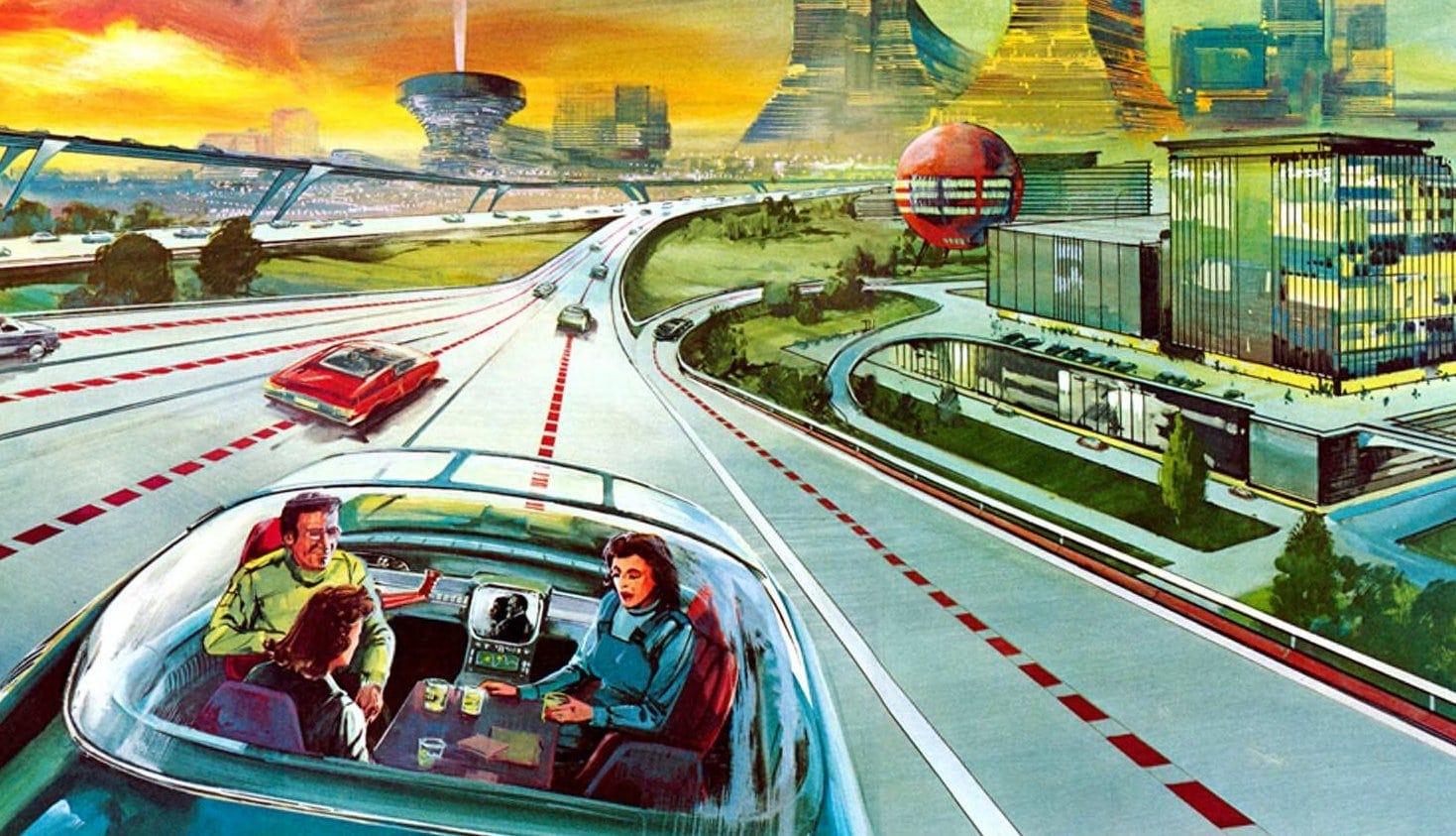
Some commentators argue that these bright, confident visions of the future have since disappeared, supplanted by cyberpunk, with its dark, pessimistic, and techno-skeptical outlook. For Franco Berardi (2013), much of contemporary Western culture has shifted from a cheerful futurism whose roots can be traced to Italian Futurism toward the anxiety-ridden imaginary of cyberpunk, which emerged in the works of Philip K. Dick and William Gibson.
Optimistic futurism has recently been revived by a coterie of tech overlords and media oligarchs, including Elon Musk, Sam Altman, Peter Thiel, and Jeff Bezos. Their ambitions range from establishing human settlements on other planets to extending life beyond death through cryogenic preservation. Yet their futurism is fueled by nostalgia for the 1950s, an era that celebrated technological sophistication through bright colors, streamlined forms, and Space Age design. Musk’s fixation on Mars, however forward-looking it may appear, is profoundly retrofuturist, drawing on the mid-twentieth-century American fascination with space exploration and the conquest of the Moon. As Walter Isaacson observes in his biography of Musk, the retirement of the U.S. Space Shuttle marked a striking reversal for a nation that, only two generations earlier, had completed nine missions to the Moon: “Beginning with the retirement of the Space Shuttle in 2011, the United States experienced a lapse in ability, will, and imagination that was astonishing for a nation that, two generations earlier, had made nine missions to the moon” (2020: 352).
Who else is interested in reinstalling futurism? The answer is: radical Islam. In this article, I compare Trumpian retrofuturist culture with contemporary Islamist fundamentalism, focusing in particular on ISIS (also known as Daesh), the transnational Salafi-jihadist militant organization. The emerging American tech oligarchy has frequently been compared to fascism, and the term techno-fascism has become commonplace. I argue that a comparison with radical Islam may prove more illuminating.
The most conspicuous similarities between ISIS and American retrofuturism are their disdain for established elites, their criticism of European-style liberalism, and their rejection of socialism. Less obvious, but more significant for my argument, is that both exemplify a form of progressive conservatism: an intellectual and cultural orientation that glorifies selected elements of the past while remaining, paradoxically, resolutely future-oriented. Rather than seeking a literal return to an earlier historical order, as traditionalists might, these movements mobilize idealized visions of the past to legitimize radically different political and technological futures. Their ambition is not simply to return to the past, but to move back to the future.
The American retrofuturist imaginary combines technological progressivism with the conservative social values of the 1950s middle class. The future it envisions is not alienated from tradition but firmly rooted in it. At its core lies a hypercapitalist universe, supposedly uncorrupted by the democratic constraints and perceived cultural permissiveness of the 1970s. It celebrates monopolistic power and technocratic control, while extravagant technological adventures become vehicles for the assertion of white masculinity. As Thiel puts it, “our cowardice has left us emasculated as well as earthbound” (Carroll 2025). The retrofuturist paradise, often envisioned as being constructed in countries of the Global South, promises to recreate the prosperity and confidence of the postwar “golden decades,” along with the global predominance of American power. Enclaves like Próspera are imagined as havens from democratic accountability, governed instead by extreme concentrations of wealth and technological authority. Trump’s insistence on oil, coal, traditional industries, and plastic must also be read as a “back to the future” ideology.

Although conservative Islamic religious elements dominate the conception of the Islamic State, the caliphate was never merely a project of historical restoration. ISIS invokes an idealized past, but it cannot be understood as simply traditionalist. More broadly, the complex intellectual and political tradition of radical Islam has sought not only to return to an idealized past but also to embrace modernity. Several strands of Islamic fundamentalism have distinctly progressive or utopian dimensions. The idea of an “Islamic modern” is evident in the Iranian Revolution, since Ayatollah Khomeini regarded himself as a progressive innovator in Shiite thought. Saudi Wahhabism, too, contains a utopian impulse: its eighteenth-century founder, Muhammad ibn ‘Abd al-Wahhab, understood traditional Islam as a degenerate form of pristine Islam and sought to inaugurate an entirely new phase of Islamic culture. The Egyptian Muslim Brotherhood conceived of itself as an “avant-garde that was ahead of and even above the ordinary masses” (Ahmed 2011: 53). Ideologues such as Sayyid Qutb, a leading figure in the Muslim Brotherhood, and Abdullah Azzam, a founding figure of al-Qaeda, were likewise distinguished by their optimistic orientation toward the future.
ISIS is particularly revealing in this respect. Its propaganda, especially in 2014, projected an image of technological modernity, featuring speeding cars, tanks, mobile phones, and computers. The organization also made extensive use of high-tech weaponry, social media, commercial bots, swarmcasting, and automated text systems.[1] Olivier Roy argues that ISIS is not backward-looking but fundamentally modern, insisting that even its violence must be understood “in parallel with other forms of violence and radicalism to which it remains closely related, such as generational revolt, auto-destruction, radical rupture with society, aesthetics of violence, inscription of the socially isolated individual within a larger globalized narrative, and apocalyptic sects” (Roy 2016: 23). John Gray advances a similar argument in his study of religion and utopia: “Islamist movements think of violence as a means of creating a new world, and in this they belong not in the medieval past but the modern West” (2007: 70).
This particular form of Islamism operates along ideological and psychological lines comparable with American retrofuturism. ISIS seeks to propel society away from what it perceives as a cyberpunk dystopia characterized by relativism, moral disorientation, and the erosion of firm convictions, toward a world governed by uncompromising, positively affirmed values. Central to this project is an unwavering belief in the possibility of a radically different future. In this sense, ISIS constructs a retrofuturist utopia: one that draws its legitimacy from an idealized past while promising a transformed social order to come. This utopian vision also carries pronounced masculinist connotations, expressed in an ethos that refuses to accommodate defeat, shame, or depression.
Libertarian tech overlords seem to be less interested in ruling existing states or conquering foreign territories than in establishing autonomous enclaves of their own. In 2014, the Islamic State proclaimed itself a worldwide caliphate and, by the end of 2015, controlled territory inhabited by approximately 12 million people. In formal terms, this project of political secession and territorial autonomy bears a resemblance to the libertarian enclaves envisioned by contemporary retrofuturists, such as Próspera in Honduras and Praxis in Uruguay, projects backed by venture capitalists and technology figures such as Altman and Thiel. The similarities are not merely superficial: they have political and cultural dimensions and are rooted, I suggest, in a shared retrofuturist imaginary.

An Islamic State sign in Raqqa, Syria.
Movements of this kind are retrofuturist by definition: they seek to turn back the wheel of time to an era when the future was imagined more optimistically. Islamists seek to revive the future envisioned in the early decades of the twentieth century, while contemporary American retrofuturists aspire to restore the technological optimism of the 1950s. Neither embraces the future that might emerge from the present. They regard the present as depressed, techno-skeptical, feminized, and woke, and imagine that its supposedly degenerate condition can lead only to a cyberpunk-style dystopia. Therefore, their response is to recover the future of the past: to restore an earlier horizon of expectation by breaking with the historical present.
The problem is that in seeking to overcome the perceived nihilism of the present, these movements risk producing a more radical form of nihilism. Because they refuse to accept the present as the starting point for an open-ended future, they seek to impose their idealized future through rupture and acceleration. For ISIS it is violence. The attempt to restore meaning and direction becomes destructive: in repudiating existing moral constraints and social arrangements as obstacles to renewal, these movements undermine the very conditions that might make a meaningful future possible. Their futurism consequently turns against its own promise. What begins as a revolt against decadence can easily end in a nihilistic embrace of destruction.
Italian Futurism encountered a similar contradiction. It glorified automobiles, industrial machinery, and modern cities while celebrating violence as a means of breaking free from the past and accelerating toward the future. Its ideal of radical renewal was inseparable from the glorification of destruction. The early Futurist “superman” embodied this contradiction: a machine-like, amoral, and insensible being liberated from conventional moral constraints. The parallels with ISIS-inspired Islamism and American oligarchic retrofuturism are striking, in aesthetic and moral term.
Despite their ideological differences, all three – Islamism, American Retrouturism, and Italian Futurism – combine a redemptive vision of the future with an ethos of rupture, domination, and destruction. In these projects, technological or ideological renewal becomes inseparable from the negation of existing moral limits, while the promised future is pursued through means that threaten to empty it of the very meaning it was supposed to restore.
References
Ahmed, Leila. 2011. A Quiet Revolution: The Veil’s Resurgence, from the Middle East to America. New Haven and London: Yale University Press.
Berardi, Franco. 2013. Dopo il futuro: Dal Futurism al Cyberpunk. L’esaurimento della Modernità. Rome: Derive Approdi.
Botz-Bornstein, Thorsten, 2019. The Political Aesthetics of ISIS and Italian Futurism. Lanham: Lexington.
Carroll, Jordan S. 2025. “Reactionary Futurism” in Los Angeles Review of Books, June 16.
Gray, John. 2007. Black Mass: Apocalyptic Religion and the Death of Utopia. New York: Farrar, Straus and Giroux.
Isaacson, Walter. 2023. Elon Musk. New York: Simon & Schuster.
Qutb, Sayyid. 1972. This Religion of Islam (Hadha al-din). Kuwait: International Islamic Federation of Student Organizations.
Roy, Olivier. 2016. Le Djihad et la mort. Paris: Seuil.
Sobchack, Vivian. 1997. Screening Space: The American Science Fiction Film. New Brunswick: Rutgers University Press.
[1] See more on “Islamic Futurism” in Botz-Bornstein 2019.